
Erythrocyte Sedimentation Rate (ESR) Blood Test
Blood tests often provide the first opportunity to explore what may be happening within the body’s organs and systems. Some blood tests guide clinicians directly toward a diagnosis. Others serve a broader role, offering important context without providing definitive answers. The blood test for erythrocyte sedimentation rate (ESR) clearly falls into the latter category.

What:
Blood biomarker
Tests for:
Inflammation levels within the body
Referral:
Required
Member cost:
Part of larger blood panel
The ESR blood test does not diagnose disease. Instead, it helps signal the possible presence of inflammation in the body and whether that inflammation may be increasing or decreasing over time. For clinicians, ESR is a useful screening and monitoring tool, and in some cases, it can offer insight when symptoms are otherwise unexplained.
The ESR blood test is included as part of the Everlab blood test, helping you uncover signs of inflammation that may not yet be obvious. By checking key inflammatory markers and having them reviewed by a qualified clinician, Everlab gives you clearer insight into what’s happening beneath the surface and what may be worth discussing next with your GP.
In this article, you’ll learn what the erythrocyte sedimentation rate test measures, how it is performed, and how results are commonly interpreted.
What Is the ESR Blood Test?
The erythrocyte sedimentation rate blood test measures how quickly red blood cells settle at the bottom of a test tube over a set period, most commonly one hour. Results are reported in millimetres per hour (mm/hr).
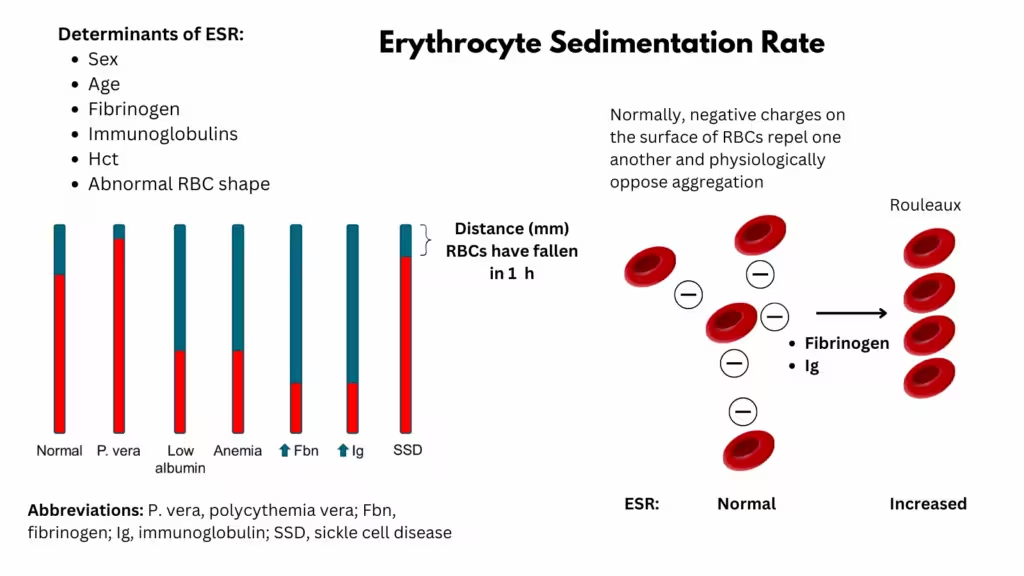
Under normal conditions, red blood cells settle relatively slowly. When inflammation is present, certain proteins in the blood increase and cause red blood cells to clump together. These clumps settle more quickly, resulting in a higher ESR value.
In simple terms, the ESR blood test reflects a physical change in how blood behaves in the presence of inflammation. However, it does not indicate where inflammation is occurring or what is causing it, which is why it cannot be used to make a diagnosis on its own.
For this reason, ESR is considered a non-specific test, but it can be a valuable complement to other blood tests, clinical assessments, and imaging studies.
The most commonly used method for measuring ESR is the Westergren method, which is widely recognised as a reliable clinical reference standard.
Why Inflammation Affects ESR
Inflammation is a natural biological response to injury, infection, autoimmune activity, or tissue damage. During inflammation, the liver produces certain proteins that enter the bloodstream and alter the surface properties of red blood cells. This change encourages the cells to clump together, causing them to settle more quickly in a test tube.
It is important to note that not all inflammation affects ESR. Localised inflammation, such as that from a small cut, needle prick, or minor sprain, is unlikely to raise ESR levels. More widespread or systemic inflammation, seen in conditions such as sepsis or lupus, is more likely to result in an elevated ESR.
ESR as a Screening Tool
Clinicians may order an ESR blood test as part of a broader evaluation when symptoms are present but the underlying cause is unclear. These symptoms can include persistent fatigue, unexplained fever, muscle pain, joint stiffness, or unintentional weight loss.
In these situations, an elevated ESR can support the possibility of an inflammatory process and prompt further investigation. A normal ESR does not rule out disease, but it can suggest a lower likelihood of significant systemic inflammation at that time.
ESR as a Monitoring Tool
One of the most useful roles of the ESR blood test is in people who have already been diagnosed with a chronic inflammatory condition and require ongoing monitoring.
Unlike some inflammatory markers that change rapidly, ESR tends to shift more slowly. This makes it suitable for assessing longer-term trends rather than short-term changes.
In conditions such as rheumatoid arthritis, polymyalgia rheumatica, and systemic lupus erythematosus, regular ESR monitoring can help assess how inflammation is responding to treatment. Falling ESR values may suggest improving inflammation, while persistently elevated values can indicate ongoing inflammatory activity and the need for reassessment.
The ESR blood test is also commonly used in conditions such as giant cell arteritis, where sustained elevation may be associated with active inflammation and increased risk of complications.
How the ESR Blood Test Is Performed
The ESR test requires a venous blood sample taken from the arm by a healthcare professional. The blood draw itself usually takes one to two minutes, and the overall process is brief.
A tourniquet is applied, the skin is cleaned with an alcohol swab, and a needle is inserted into a vein to collect the blood sample. After collection, the needle is removed and the site is covered to minimise bleeding.
You may experience mild discomfort or bruising at the site, which typically resolves quickly. The blood sample is then placed in a tall, narrow tube for one hour to measure the sedimentation rate.
The ESR test is generally considered low risk, and most people can resume normal activities straight after the test.
Preparing for an ESR Test
No specific preparation is required for an ESR test. If other blood tests are being performed at the same time, you may need to follow preparation instructions for those tests.
It is also important to tell your doctor about any medicines you are taking, as some can influence ESR results. These include corticosteroids and non-steroidal anti-inflammatory medicines (NSAIDs), which may reduce inflammation.
Factors That Can Affect ESR Results
While ESR reflects inflammation, several non-inflammatory factors can also influence results. These include dehydration, increasing age, anaemia, pregnancy, and kidney disease.
Testing technique can also affect results. Although the Westergren method is standard, factors such as sample handling and timing can influence accuracy.
What Is Considered a Normal ESR?
Normal ESR values vary by age, sex, and laboratory reference range. In general, ESR tends to be lower in younger individuals and higher in older adults, with women typically having slightly higher values than men.
Common reference ranges include:
- Newborns (0–31 days): 0–4 mm/hr
- Infants (31–91 days): 0–9 mm/hr
- Children (91 days to 12 years): 0–14 mm/hr
- Men (12–65 years): 1–15 mm/hr
- Men (over 65 years): 1–30 mm/hr
- Women (12–18 years): 1–15 mm/hr
- Women (18–65 years): 1–20 mm/hr
- Women (over 65 years): 1–35 mm/hr
ESR results must be interpreted against the appropriate reference range. A result outside the normal range does not automatically indicate a problem, as interpretation depends on individual circumstances and other test results.
What Does a High ESR Mean?
A high ESR indicates that red blood cells are settling faster than expected, which can suggest the presence of inflammation. However, it does not identify the source or cause.
Elevated ESR levels may be seen in autoimmune conditions, chronic infections, inflammatory arthritis, some cancers, or severe systemic illness. Higher values can sometimes be associated with more active inflammation, but ESR does not reliably indicate disease severity on its own.
Non-disease factors such as pregnancy, anaemia, and increasing age can also raise ESR, which is why the test is never assessed in isolation.
What Does a Low ESR Mean?
A low ESR means that red blood cells are settling more slowly than expected and is usually considered reassuring.
In rare cases, a low ESR may be associated with conditions that affect red blood cell number or shape, such as polycythaemia vera or sickle cell disease. For most people, however, a low ESR is not a cause for concern.
ESR and C-Reactive Protein: How They Compare
ESR and C-reactive protein (CRP) are both markers of inflammation, but they behave differently and are often used together.
CRP is produced directly by the liver and rises quickly in response to inflammation, sometimes within hours. ESR increases more gradually and is better suited to tracking longer-term inflammatory trends.
When ordered together, these tests provide a more complete picture of inflammatory activity.
ESR in Chronic Disease and Long-Term Monitoring
In chronic inflammatory and autoimmune conditions, ESR is often used to monitor trends over time rather than relying on a single result.
Stable or decreasing values may suggest reduced inflammatory activity, while rising values can prompt reassessment of treatment or further investigation. In these settings, ESR supports clinical decision-making but does not guide it alone.
ESR’s Limitations
ESR has clear limitations. It does not identify the cause or location of inflammation and can be influenced by many non-inflammatory factors.
A normal ESR does not exclude disease, and an elevated ESR does not confirm a diagnosis. Results should always be interpreted alongside symptoms, clinical findings, and other investigations.
For this reason, it is important to discuss ESR results with a healthcare professional who can place them in the appropriate clinical context.
Why It Still Matters
Despite the availability of more specific biomarkers, ESR remains useful because it is simple, low-cost, and informative when used appropriately.
As a screening and monitoring tool, it can help guide further testing, assess disease activity over time, and evaluate response to treatment when combined with other clinical information.
Conclusion
The ESR blood test provides insight into inflammatory activity in the body, but it cannot diagnose disease on its own. When used alongside other markers such as C-reactive protein and interpreted in context, ESR contributes to a broader understanding of health trends, chronic disease activity, and treatment response.
The Everlab program measures a wide range of blood markers, including inflammatory markers such as C-reactive protein. Results are reviewed by a qualified clinician and reported in context to support informed discussions with your GP about your health.
Why is an ESR Blood Test Important?
An ESR blood test helps indicate whether there is inflammation occurring somewhere in the body, even when symptoms are unclear. While it cannot diagnose a specific condition, it provides useful context that can guide further investigation and help monitor changes in inflammatory activity over time.
Additional FAQs
%402x%20(2).svg)


imaging
biomarkers
sterols
Book a Free Discovery Call
Join 20,000+ Australians improving their health with proactive, personalised healthcare.